Power Tubes
The power stage takes the voltage signal created by the preamplifier and delivers substantial power to the output transformer and loudspeaker. Different power-tube families have different electrical limits and require compatible heater supplies, sockets, output-transformer impedances, bias arrangements, and plate/screen voltages.
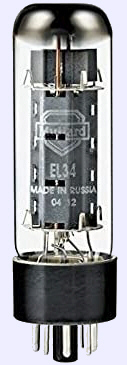 EL34
Power pentode family strongly associated with British-style guitar amplifiers.
EL34
Power pentode family strongly associated with British-style guitar amplifiers.
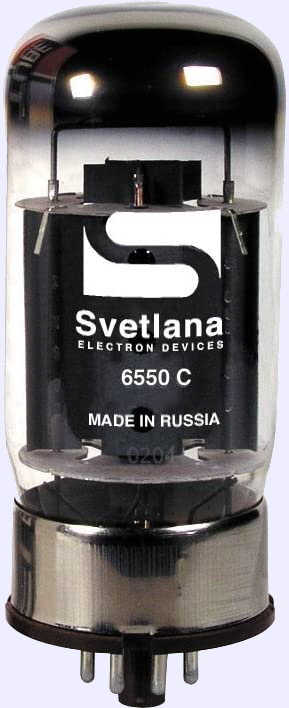 6550
High-power beam tube used in audio, musical-instrument, and industrial equipment.
6550
High-power beam tube used in audio, musical-instrument, and industrial equipment.
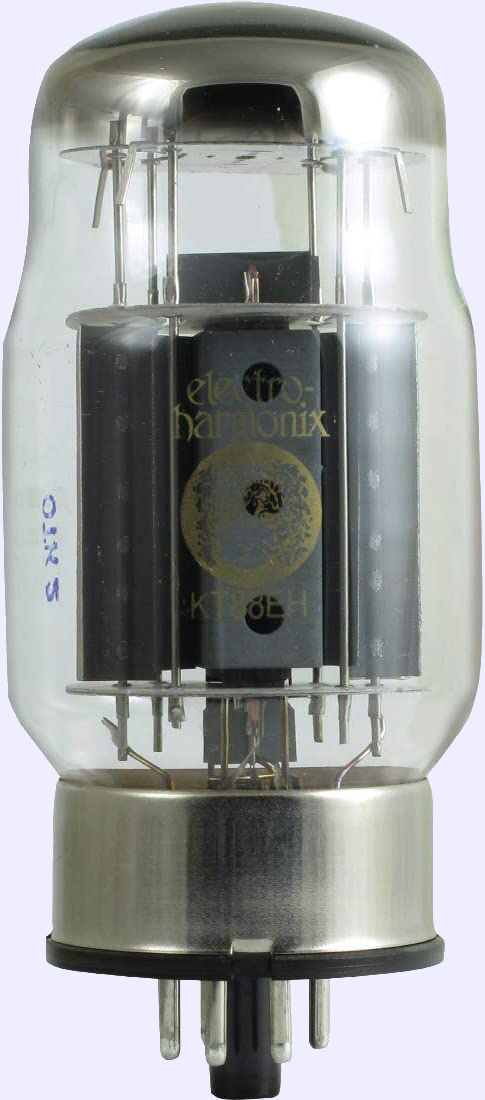 KT88
High-power beam tetrode used in hi-fi and musical-instrument amplifiers.
KT88
High-power beam tetrode used in hi-fi and musical-instrument amplifiers.
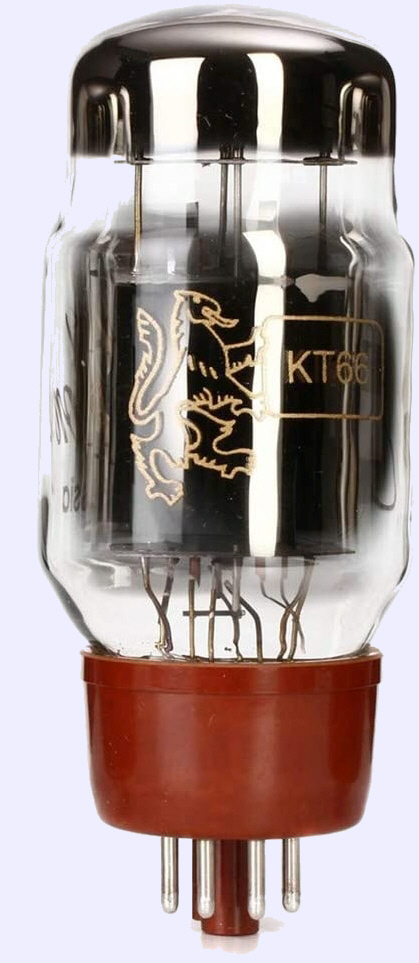 6L6 family
The supplied photograph is visibly marked KT66, a related but distinct beam-tetrode type.
6L6 family
The supplied photograph is visibly marked KT66, a related but distinct beam-tetrode type.
images/6l6.png as requested.
EL34
The EL34 is a power pentode strongly associated with British amplifiers, especially many Marshall designs. Guitarists often describe it as having a forward midrange and a characteristic transition into overdrive, but those descriptions are subjective and depend heavily on the complete amplifier, transformer, speaker, bias, and operating voltage.
6L6 family
The 6L6 is a beam-power tube introduced in the 1930s and used extensively in American audio, radio, and musical-instrument amplifiers. Fender amplifiers made the family especially familiar to guitarists. Variants differ in allowable plate voltage, dissipation, construction, and ratings.
The KT66 is a related beam-power tube developed in Britain. It can sometimes be used in circuits associated with 6L6-family tubes, but heater current, physical size, bias, operating voltage, and transformer loading must be checked rather than assuming direct interchangeability.
6550
The 6550 is a large beam-power tube capable of substantial output power. It appeared in hi-fi and musical-instrument amplifiers and was used in some American-market Marshall amplifiers as well as Ampeg designs.
KT88
The KT88 is another high-power beam tube, associated with both hi-fi amplifiers and high-powered musical-instrument designs. It can operate at substantial plate voltage and power, but the amplifier must be designed or properly modified for it.
6V6
The smaller 6V6 beam-power tube is closely associated with lower-powered American guitar amplifiers. Its lower output capability can make it practical to reach power-stage distortion at less acoustic output than a pair of 6L6, EL34, 6550, or KT88 tubes.
Bias and matching
Power tubes used in push-pull pairs or quartets are often purchased as matched sets. Matching means that selected tubes have reasonably similar measured characteristics under specified test conditions. Bias adjustment then sets the operating point in the amplifier.
Output transformer
A loudspeaker may be only 4, 8, or 16 ohms, while a tube power stage requires a much larger effective plate-to-plate load. The output transformer converts between those impedance levels and keeps the loudspeaker from carrying the high DC plate voltage.
Screen grids
Pentodes and beam tubes have screen grids that may draw significant current. Screen resistors, voltage, and dissipation are important to reliability, especially when a guitar amplifier is driven into clipping.
Red plating
If plate dissipation becomes excessive, part of the plate structure can begin glowing red. This is not normal heater glow—it is evidence of serious overheating caused by incorrect bias, runaway, a tube fault, or another circuit problem.